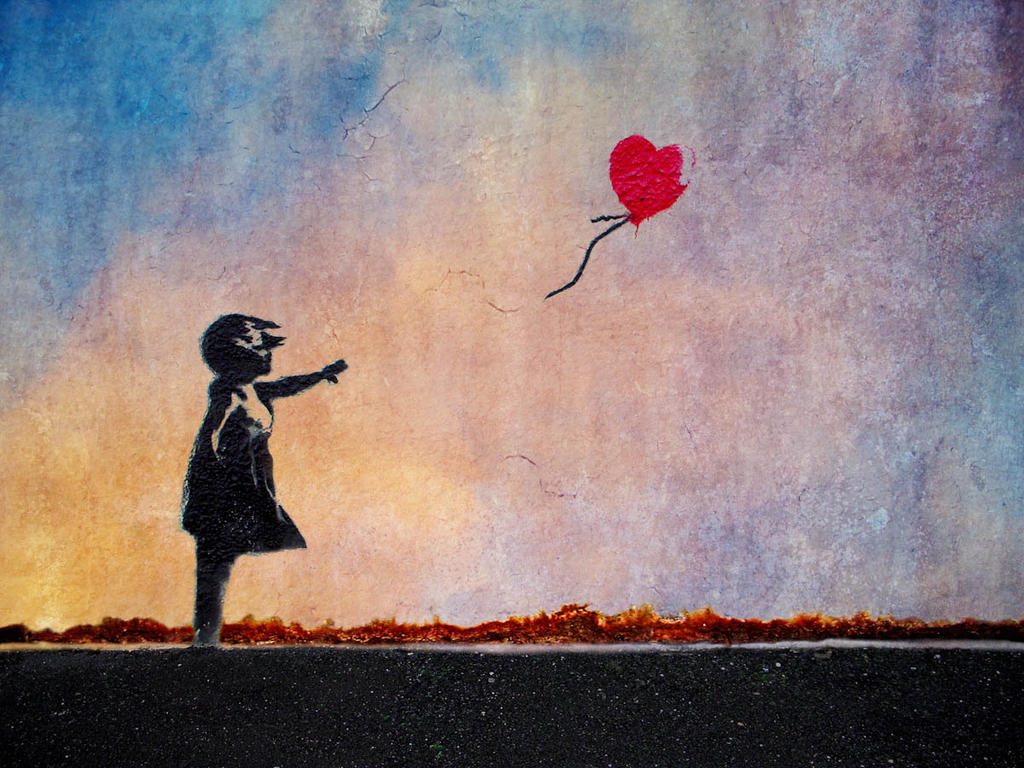
Banksy by Shepard FaireyOne of the most inappropriate nicknames of all time, at least in my opinion, belonged to Ronald Reagan: “The Great Communicator,” who we’ve come to learn did a pretty shitty job of communicating the government’s problems and indiscretions. A nickname like that deserves a more righteous, honest owner—someone like BANKSY.
Most people think of art as a way of conveying emotions, as opposed to language, the means by which we express ideas. Whatever line there is distinguishing art and language, BANKSY paints over it to make it disappear, then stealthily repaints it in the unlikeliness of places. His works, whether he puts them on the streets, sells them in galleries, or hangs them in museums on the sly, are filled with imagery tweaked into metaphors that cross all language barriers. The images are brilliant and funny, yet so simple and accessible that even children can find the meaning in them: even if six-year-olds don’t know the first thing about culture wars, they have no trouble recognizing that something is amiss when they see a picture of the Mona Lisa holding a rocket launcher. A lot of artists can be neurotic, self-indulgent snobs using art for their own catharsis, but BANKSY distances himself from his work, using art to plant the feelings of discontent and distrust of authority that anyone can experience when he prompts them to ask themselves one gigantic question: Why is this wrong? If it makes people feel and think, he’s accomplished his goal.
BANKSY’s work embodies everything I like about art and nothing I dislike about it. His art is accessible rather than elitist, since he does it on the street; it has a powerful political message that’s conveyed with a sense of humor, which certainly makes the bitter pill easier to swallow; it’s pleasing to look at, because it’s technically very strong but not overly complex and intimidating; and he pulls it off in such a way that its presence in its context communicates not only his message but his dedication to effecting the change he promotes in that message, whether he’s defying Israeli hegemony by painting the separation wall in Palestine or bypassing the elitist review board of a museum by hanging his work himself. He definitely has his share of critics, who say that he burns too many bridges by rejecting countless opportunities to gain money or fame, but he simply has no interest in doing anything that falls outside his goal of making provocative, powerful artwork. He’s a good friend and a tremendous source of inspiration; he’s The Great Communicator of our time, and the most important living artist in the world.
How long are you going to remain anonymous, working through the medium itself and through your agent as a voice for you?
B: I have no interest in ever coming out. I figure there are enough self-opinionated assholes trying to get their ugly little faces in front of you as it is. You ask a lot of kids today what they want to be when they grow up, and they say, “I want to be famous.” You ask them for what reason and they don’t know or care. I think Andy Warhol got it wrong: in the future, so many people are going to become famous that one day everybody will end up being anonymous for 15 minutes. I’m just trying to make the pictures look good; I’m not into trying to make myself look good. I’m not into fashion. The pictures generally look better than I do when we’re out on the street together. Plus, I obviously have issues with the cops. And besides, it’s a pretty safe bet that the reality of me would be a crushing disappointment to a couple of 15-year-old kids out there.
What got you into graffiti? I know that you did more traditional graffiti at one point.
B: I come from a relatively small city in southern England. When I was about 10 years old, a kid called 3D was painting the streets hard. I think he’d been to New York and was the first to bring spray painting back to Bristol. I grew up seeing spray paint on the streets way before I ever saw it in a magazine or on a computer. 3D quit painting and formed the band Massive Attack, which may have been good for him but was a big loss for the city. Graffiti was the thing we all loved at school – we all did it on the bus on the way home from school. Everyone was doing it.
What’s your definition of the word “graffiti”?
B: I love graffiti. I love the word. Some people get hung up over it, but I think they’re fighting a losing battle. Graffiti equals amazing to me. Every other type of art compared to graffiti is a step down—no two ways about it. If you operate outside of graffiti, you operate at a lower level. Other art has less to offer people, it means less, and it’s weaker. I make normal paintings if I have ideas that are too complex or offensive to go out on the street, but if I ever stopped being a graffiti writer I would be gutted. It would feel like being a basket weaver rather than being a proper artist.
Who are some of your favorite graffiti artists?
B: My favorite graffiti is done by people that aren’t in books. I’m really into the amateurs, the people who just come out of nowhere with a marker pen and write one funny thing for one night and then disappear.
“Street art” has been the cool buzzword, and artists have obtained instant credibility from these new fly-by-night galleries, skate companies wanting to do a new street art t-shirt series, whatever. All these people are picking artists that deserve to be picked and have really done work on the streets for 10 to 15 years, but then they also pick a lot of artists that have been doing something for four to six months and built themselves a nice little website. Where do you see yourself fit into that? If the pedestrians at these companies don’t really know who’s done what, how do you separate yourself from that?
B: Most graffiti writers arrive at a style by the need to work fast and quiet. If you arrived at a style by painstakingly drawing in your bedroom and touching up on Photoshop, then people can smell the difference from about five miles away.
How do you decide what commercial projects to work on?
B: I’ve done a few things to pay the bills, and I did the Blur album. It was a good record and it was quite a lot of money. I think that’s a really important distinction to make. If it’s something you actually believe in, doing something commercial doesn’t turn it to shit just because it’s commercial. Otherwise you’ve got to be a socialist rejecting capitalism altogether, because the idea that you can marry a quality product with a quality visual and be a part of that even though it’s capitalistic is sometimes a contradiction you can’t live with. But sometimes it’s perfectly symbiotic, like the Blur situation.
I’m sure you get offered jobs left and right. Are there things that you think about doing that you don’t do, or things that you wish you would’ve done?
B: I don’t do anything for anybody anymore, and I will never do a commercial job again. In some ways it’s a shame, cuz I’m sure I’d have had a good time doing posters for that frozen yogurt company in Hawaii and now I’d have friends I could go visit on the other side of the world. But it’s part of the job to shut the fuck up and not meet people. I never go to the openings of my shows, and I don’t read chat rooms or go on MySpace. All I know about what people think of my gear is what a couple of my friends tell me, and one of them always wants to borrow money, so I’m not sure how reliable he is.
I think there’s a lot to be said for the fine line between secondguessing yourself and respecting a dialogue with people whose opinions you trust, or even people that are great because they don’t know shit about art and you get the most honest reaction from them. Because so many artists, they worry about what trends are happening in art and design and street art, they read too many magazines, and they are too wrapped up in everything; they’re paralyzed.
What’s the most perfect non-traditional piece of art that you’ve seen that’s not currently hanging in a museum?
B: The most perfect piece of art I saw in recent times was during an anarchist demonstration in London a couple of years ago. Someone cut a strip of turf from the grass in front of Big Ben and put it on the head of the statue of Winston Churchill. Later, the demo turned into a riot, and photos of Winston with a grass Mohican were on the cover of every single British newspaper the next day. It was the most amazing bit of vandalism, because it was the perfect logo for this eco-punk movement that was trying to reclaim the streets, bring an end to global capitalism, and defend the right to sit in a park all day getting wasted on discount lager.
Your art is still free on the streets but costly in the galleries. What dictates that?
B: What I find is I don’t have much say in what things cost. Every time I sell things at a discount rate, most people put them on eBay and make more money than I charged them in the first place. The novelty with that soon wears off.
You were talking about how you want your books to be cheap because they show the work in the context of the street, as well as the installations in museums and other pranks, which are actually honest representations of your work. But then people want objects, so they’re going to want the canvases and things like that, and you’re just kind of accepting that people fetishize objects and are willing to pay a lot for the status of owning something that they can hang up.
B: I stenciled the door of an electrical block in south London and recently someone sawed it off and sold it at a famous auction house for £24,000, but in that same week Islington council power sprayed off eight of my new stencils on one road. What I’m finding is art is worth whatever someone is willing to pay for it, or willing to pay to not have to look at it.
The redistribution of the wealth then allows you to have that freedom to put work on the street without the pressure of having to sell a thousand cheap canvases – work that’s free and accessible. It really means that the art objects, the canvases, only really play into the people that think in an elitist way and have the money. So really, it kind of balances out. That’s an issue that a lot of artists have. They believe that their work should be accessible to a lot of people, and that actually is the opposite of the way the art world works.
B: The art world is the biggest joke going. It’s a rest home for the overprivileged, the pretentious, and the weak. And modern art is a disgrace – never have so many people used so much stuff and taken so long to say so little. Still, the plus side is it’s probably the easiest business in the world to walk into with no talent and make a few bucks.
The murals you did in Palestine, I would assume, involved personal risk. You’re there, and you could definitely get some people pissed off and put yourself in jeopardy.
B: Every graffiti writer should go there. They’re building the biggest wall in the world. I painted on the Palestinian side, and a lot of them weren’t sure about what I was doing. They didn’t understand why I wasn’t just writing “down with Israel” in big letters and painting pictures of the Israeli prime minister hanging from a rope. And maybe they had a point. The guy that I stayed with got five days with the “dirty bag” for waving a Palestinian flag out a window. The dirty bag is when Israeli security services get a sack, wipe their shit on it, and put the bag over your head while your hands are tied behind your back. I spat out my falafel as he was explaining that to me, but he just goes, “That’s nothing. My cousin got it for two weeks without a break.” It’s difficult to come home and hear people complaining about reruns on TV after that. It’s very hard for the locals to paint illegally over there. We certainly weren’t doing it under the cloak of darkness; you’d get shot. We were out in the middle of the day, making it very clear we were tourists. Twice, we had serious trouble with the army, but one time the Palestinian border patrol pulled up in an armored truck. The Israeli government makes a big fuss about how they own the wall, despite building it right through the farmland of Palestinians who have been there for generations, so the Palestinian border police don’t give a shit if you paint it or not. They parked between the road and us, gave us water, and just watched. It’s probably the only time I’m ever going to paint whilst being covered by a cop from a roof-mounted submachine gun.
Did they realize that it favored the Palestinian perspective?
B: I have sympathy for both sides in that conflict, and I did receive quite a bit of support from regular Israelis, but if the Israeli government had known we were going over there to do a sustained painting attack on their wall, there’s no way that we’d have been tolerated. They’re very paranoid. They don’t want the wall to be an issue in the West. On the Israeli side of the wall they bank it up with soil and plant flowers so you don’t even know its there. On the Palestinian side it’s just a fucking huge mass of concrete.
You’ve never really been busted to the point of potentially not being able to do street art, but that’s always a possibility. I could be wrong – you could be incredible and never get caught, but everybody gets caught at some point. What would you do if you were put in that position? Would you rent walls? Would you try to find legal walls? Would you still try to find ways to have work on the street and still maintain your anonymity to a degree, but keep it out there through more legal means? Would you move to another country? What would you do?
B: I’m always trying to move on. You’re not supposed to get dumber as you get older. You’re not supposed to just do the same old thing. You’re supposed to find a new way through and carry on. I invest back into the street bombing from selling shit. Recently, I’ve been pretending to be a construction manager and paying cash to get scaffolding put up against buildings, then I cover the scaffolding with plastic sheeting and stand behind it making large paintings in the middle of the city. I could never have done that a few years ago. Plus, I’m always interested in finding new places to hit up; it’s easier to break into zoos and museums than train lay-ups, because they haven’t had so much of a graffiti problem in the past. Ultimately, I just want to make the right piece at the right time in the right place. Anything that stands in the way of achieving that piece is the enemy, whether it’s your mum, the cops, someone telling you that you sold out, or someone saying, “Let’s just stay in tonight and get pizza.”
check out
www.banksy.co.ukWale & Pharrell - Inhibitions (Let It Loose)Chromeo - Night By Night (Skream Remix)Kid Cudi - Pursuit Of Happiness (Benny Bennassi Remix)